
 EN
Understand Engine Thermal Load to Size Your Oil Cooler
Why thermal load—not just engine type—dictates oil cooler capacity
Motor oil performs optimally between 180°F and 220°F (82°C–104°C). Above ~300°F (149°C), oxidation accelerates, viscosity degrades, and sludge formation increases sharply. Relying solely on engine category—e.g., “V6” or “turbo-4”—to size an oil cooler ignores the true driver of cooling demand: thermal load. Two engines with identical displacement can generate vastly different heat rejection requirements depending on operating conditions. A high-rpm track engine or a diesel under sustained towing stress produces far more heat than its low-load counterpart—even if both share the same block. A properly sized oil cooler must reject enough heat to maintain safe oil temperatures at peak continuous output, not just during typical driving. That’s why a street-tuned version of a platform often needs significantly more cooling than its factory-spec sibling. Thermal load determines required heat transfer area and airflow before fitment constraints enter the equation—making it the foundational sizing variable.
How displacement, power output, and duty cycle determine heat rejection requirements
Displacement sets the baseline volume of oil circulating through hot zones—bearings, pistons, turbos—but heat rejection scales with how much and how long energy enters that oil. Power output directly increases combustion-derived heat flux into the oil film; a 250 hp tune may overwhelm a cooler sized for the stock 150 hp configuration. Duty cycle governs duration and intensity: short-trip commuter use allows sufficient heat dissipation via the oil pan, while continuous towing, desert operation, or track sessions demand dedicated, high-capacity cooling. In practice, heat rejection is best modeled as the product of heat input rate and exposure time—not displacement alone. For instance, a 2.0 L turbocharged race car frequently requires more oil cooling than a 5.0 L naturally aspirated sedan under gentle highway loads. Heavy-duty diesel and motorsport applications therefore calculate steady-state heat rejection at peak torque, then apply a safety margin (typically 15–25%) for elevated ambient temperatures and reduced airflow. This ensures stable oil temperature even when cooling is compromised—avoiding both overcooling and dangerous heat soak.
Compare Oil Cooler Types: Air-to-Oil, Liquid-to-Oil, and Integrated Systems
Matching oil cooler type to operating environment and cooling medium availability
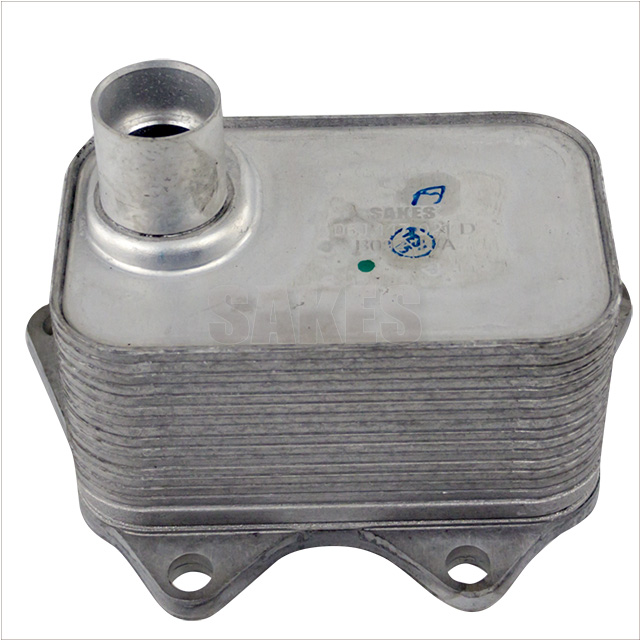
Air-to-oil coolers are ideal for moderate climates and applications with consistent, unobstructed airflow—such as front-mounted units in passenger cars or motorcycles. They reject heat directly to ambient air, simplifying installation and minimizing failure points. However, their effectiveness drops significantly when airflow is restricted (e.g., low-speed off-road use) or ambient temperatures climb above 95°F (35°C). Liquid-to-oil coolers use engine coolant as the secondary medium, offering higher heat capacity per unit volume and faster cold-start warm-up. They’re especially valuable where space is limited or airflow unreliable—like in trucks, diesels, or tightly packaged performance vehicles. Integrated systems embed a liquid-to-oil core inside the oil filter housing or an engine-mounted module, leveraging existing coolant circuits and eliminating external plumbing. Selection should prioritize real-world cooling medium availability, ambient conditions, and packaging realities—not theoretical peak ratings.
Evaluating pressure drop, efficiency (ΔT), and packaging constraints across designs
Liquid-to-oil stacked-plate cores deliver high ΔT (temperature differential across the cooler) in compact footprints but shift additional heat to the radiator—potentially overloading an already marginal cooling system. Air-to-oil units avoid this secondary burden but require larger frontal area and precise ducting to ensure laminar flow, making them harder to package in modern, aerodynamically optimized engine bays. Integrated modules reduce hose runs and leak points, yet internal passage geometry must preserve adequate oil flow to critical bearings—especially at hot idle. Excessive pressure drop (>10 psi at rated flow) risks starving main bearings and wasting pump energy. Always evaluate restriction and ΔT under worst-case conditions—not just steady cruise—including high ambient temps (110°F/43°C), low-speed load, and elevated oil viscosity. A balanced design stabilizes oil temperature without compromising primary cooling function or engine lubrication integrity.
Apply Engine-Specific Oil Cooler Selection Guidelines
Key features for common engine classes: motorcycle, passenger car, light truck, HD diesel, and racing
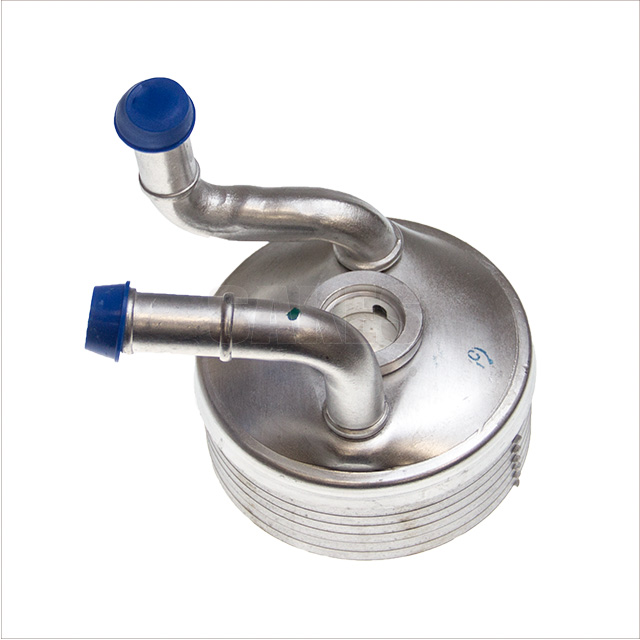
Motorcycle oil coolers are typically compact air-to-oil units mounted directly in the front airstream. Stock engines often perform well with modest fin-density cores, while modified or track-focused bikes benefit from larger cores or auxiliary fans to offset limited airflow at low speed and high RPM. Passenger cars—especially turbocharged or performance variants—commonly use liquid-to-oil heat exchangers integrated into the coolant loop, though compact air-to-oil options remain viable where radiator space permits. Light trucks and SUVs used for towing or off-road work gain reliability from robust stacked-plate air-to-oil coolers with moderate capacity and simple grille-mounting solutions. Heavy-duty diesel engines demand liquid-to-oil coolers rated in kilowatts (kW), engineered for sustained high-load operation and compatibility with high-exhaust-gas-temperature (HEGT) aftertreatment systems. Racing and high-performance engines prioritize cooling efficiency per unit weight: bar-and-plate or tube-and-fin designs with AN-10 or larger fittings, remote mounting, and fully ducted airflow maximize ΔT under extreme track conditions.
Critical OEM trends: thermostatic bypass valves and smart thermal management in modern turbocharged engines
Modern OEMs increasingly integrate thermostatic bypass valves into oil cooler circuits to optimize warm-up behavior and prevent overcooling. These valves remain closed until oil reaches a calibrated threshold—typically 80°C to 95°C—ensuring viscosity stabilizes quickly after cold starts. Turbocharged gasoline and diesel engines, which generate disproportionately high heat per liter, now routinely feature intelligent thermal management: electronically controlled valves or variable-displacement oil pumps route oil through the cooler only when needed. This reduces parasitic losses, improves fuel economy, and enhances cold-weather drivability. When selecting an aftermarket oil cooler, prioritize units that either include a built-in thermostatic valve or are compatible with an external thermostatic sandwich plate. This capability is essential for daily-driven turbocharged vehicles—particularly in cold climates—where uncontrolled cooling can delay oil warm-up and accelerate wear.
FAQs
What is the optimal oil temperature range?
The optimal oil temperature range is between 180°F and 220°F (82°C–104°C). Temperatures exceeding ~300°F (149°C) can degrade oil quality.
Why is thermal load more important than engine type?
Thermal load dictates how much heat the engine generates under specific conditions. Two engines of the same displacement can produce vastly different cooling demands based on power output and usage.
What are the benefits of liquid-to-oil coolers?
Liquid-to-oil coolers offer higher heat capacity per unit volume and faster warm-up times, making them ideal for situations with limited airflow or space constraints.
How can high-pressure drops affect performance?
Excessive pressure drops (>10 psi at rated flow) can starve bearings and waste pump energy, potentially damaging engine lubrication integrity.
Are thermostatic bypass valves necessary for oil coolers?
Yes, these valves optimize warm-up behavior, prevent overcooling, and are essential for turbocharged engines in cold climates.